Three weeks of discovery. What would've taken eight.
Step Up Tutoring · Discovery → Prototype → Launch plan · Compressed with AI
Built on our Spectra philosophy — one shared source of truth, every stakeholder’s perspective.
How it came together
A referral from inside the board.
Ankita Kaul — Vice Chair of Step Up’s Board of Directors, and Director of Innovation & Technology at Stanford’s HEARTS Lab — introduced us. She’d seen our work through a Stanford engagement and knew the Step Up team needed partners who could move fast without breaking what was already running. She watched the discovery unfold alongside the team.
“Btw — had the SUT team seen the vibe-coded dashboard previously at all? I’m sure folks that haven’t seen it before may have their mind blown.”
The client
Step Up Tutoring
Step Up Tutoring is a nonprofit serving tutors, students, and families across Los Angeles. Over the years, their operations had accumulated a patchwork of tools — an operational database holding matches and session history, a workflow-automation layer stitching those tables into daily rhythms, and roughly a dozen integrated systems feeding in from every direction. Every new feature cost more than the last, every audit question took weeks. Operations could not stop while any of this was examined. The board wanted a clear answer: rebuild, or keep patching? They brought us in to find out — fast, and without anything breaking underneath. The shape repeats across sectors: the same play runs for healthcare systems, regional banks, manufacturers, and civic agencies — different stacks, same board waiting for an answer, same rule that operations cannot stop.
Our process
Five steps, three weeks.
Same five moves we would have made in seven or eight weeks without AI. Agents did the audit, the mapping, the option-modelling, and the plan-drafting — our team did the stakeholder conversations, the judgment calls, and the board-facing framing.
What comes next
Build phase — agents and humans, side by side.
Discovery produced the map and the plan. The build phase runs the same way — AI agents doing the work that scales, our engineers making the calls that don’t.
What agents will do
- Stand up the new admin platform module by module, test-first.
- Run the migration against a shadow copy before the live cutover, every day.
- Keep the decision record current — every trade-off written down as it happens.
- Flag drift between the plan and the build the moment it shows up.
What the team will do
- Own the stakeholder conversations — families, tutors, operations, board.
- Sign off on each migration gate before the next module goes live.
- Make the judgment calls AI shouldn’t — scope changes, exceptions, timing.
- Keep operations running the whole time. That is the measure.
Every source the team already uses — the operational database, the workflow-automation tool, Gmail, Zoom, Slack, Figma — feeds one shared record. Agents read from it and write back to it. Every stakeholder sees the surface tuned to them.
What we handed over
A prototype the team could click through.
Four screens that made the rebuild argument tangible. One shown in full below, three summarized beside it. Not a shipped platform — a clickable preview that turned the board conversation from “maybe” to “when.”
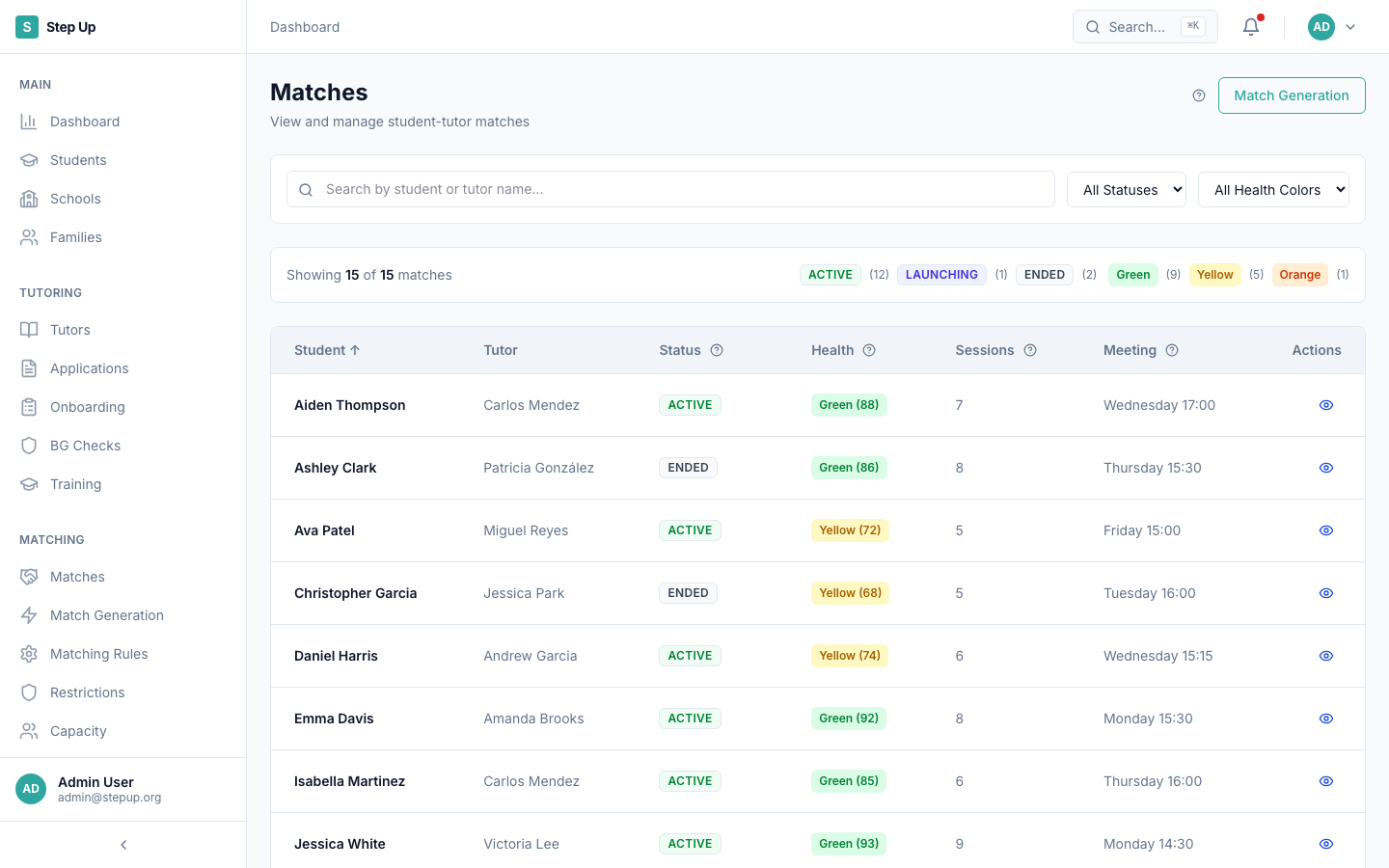
Tutor-matching surface
Matches dashboard — prototype
The daily view — prototyped in days with AI. Active tutor-family matches with a single health score per row. Operations could see what they’d have — green, yellow, orange — without a single line of production code written.
Scope & budget surface
The board’s view. Engagement scope, phased rollout, and the downtime budget — prototyped so the decision-makers could argue with it.
Session-tracking surface
Operations’ view. Per-session logs, tutor notes, engagement signals — what the live system would feel like once built.
Board dashboard
Every decision, every phase, every module — surfaced for the stakeholders who sign the check.
Outcomes
What the team walked out of discovery with.
- A full audit of the operational database, the workflow-automation layer, and the twelve integrated systems — read against real stakeholder needs, not assumptions.
- Three migration paths modelled side by side, each with its downtime profile and operational-risk profile — so the board could pick with eyes open.
- A clickable prototype of the future admin experience — enough for operations, tutors, and the board to see the rebuild before committing to it.
- A launch plan designed around the one rule we could not break: operations cannot stop.
Want to go deeper?
Every interview, every audit finding, every migration option, every line of the launch plan is queryable. Ask the Step Up engagement anything — answers are cited from the actual project documents, sanitized of any confidential detail.
A first engagement, sized to your stack.
The playbook compresses the same way whether you are a five-thousand-person health system, a regional bank, a state agency, or a fifty-person operations team. A week of listening, a week of auditing, a week of shaping the answer. Here is what the first three weeks would look like if we started next Monday.
Week 1
Listen and frame.
We sit with the three or four stakeholder voices who matter most — whoever is closest to the problem, whoever signs the decision, whoever operates the thing day to day. You get back a one-page brief that names the real constraint, not the easy one.
Week 2
Audit the stack.
Our agents catalogue every table, every automation, every integration that touches the area in scope. You get a readable map — one document — of what you actually have, versus what you think you have. Your InfoSec lead gets the vendor-risk packet that same week.
Week 3
Shape the options.
Three paths modelled side by side, each with a cost profile, a timeline profile, and a risk profile. You walk into the next board meeting with a defensible recommendation already on paper and a clickable prototype people can argue with.
Prefer to kick the tires first? Forward your three biggest unknowns to mayuresh@betacraft.io and we’ll come to the first call already prepared.
Teams and organizations we have built for
We have built platforms, AI tooling, and full products for partners across education, philanthropy, research, healthcare, fintech, civic tech, and aerospace. The list below is a partial cross-section — some engagements are under NDA, some are pre-launch — and every logo here is work we can walk through on a Zoom.






Who is BetaCraft
BetaCraft is an AI-native product engineering firm — agents ship code alongside humans on every engagement. Led by founder Ratnadeep Deshmane and partner Mayuresh Soni — both serial founders who built, scaled, and exited digital products before joining forces at BetaCraft. We run digital transformation for mission-driven institutions across education, tutoring, philanthropy, research, and healthcare.
Education is not new territory. Step Up Tutoring — the engagement on this page — came to us through Ankita Kaul, Vice Chair of Step Up’s Board of Directors and Director of Innovation & Technology at Stanford’s HEARTS Lab. Our active Georgetown University partnership ships credential-to-jobs data visualization across fifty-five U.S. metros for the Center on Education and the Workforce. Our long-running Stanford Solutions Science Lab partnership (Our Voice, CORD) is delivered by a remote eight-engineer squad working in daily partnership with the California-based faculty team. For Step Up, the points of contact are named and accountable: Mayuresh Soni as engagement lead, Chetan Phatak as tech lead.
Our engineers slot directly into your delivery process — discovery calls, stakeholder interviews, approval gates, security and vendor-risk review — and rewire it from the inside. Six-week discoveries compress to two. Quarterly release trains compress to weekly. Your internal team gets faster without getting bigger.
That is how the Step Up discovery wrapped in weeks, not months. Every person on the project team moves the work forward directly, not just the engineers. The executive director asks a question in plain English and gets a sourced answer. The operations lead files a concern and it lands as a tracked risk. Engineers prototype; everyone else stops waiting on a ticket and starts shaping the build too.
Enterprise buyers ask how we get through their vendor-risk and InfoSec review — so we answer that upfront. Every engagement ships with phased sign-off gates at the module level, a rollback path executable inside a single business day, vendor-risk packets ready for the questionnaires clients actually send, and SLAs written to match the client’s procurement standards. The compliance experience listed below is the public face of that same discipline.
We work through a philosophy we call Spectra: one shared source of truth per project, refracted so every stakeholder — from the board to the operations team to the tutors and families — sees what matters to them, in their voice.
- Clients served
- 50+
- Projects delivered
- 150+
- Shipping since
- 2019
Compliance experience
We are not a certified entity — we build products that pass our clients’ audits. BetaCraft engineers have shipped into these regulatory regimes end-to-end: requirements mapping, control implementation, audit support, remediation.
FERPA — built for
Education platforms handling student records under client FERPA review.
SOC 2 Type II — built for
DevSecOps stack wired into client certifications.
HIPAA — built for
Telehealth and medical-imaging products — passed client HIPAA audits.
Nonprofit-sector fit
Board-ready reporting, phased rollout planning, audit-trail documentation — built into every engagement.
A case study from BetaCraft · Running on Spectra.
Spectra platform